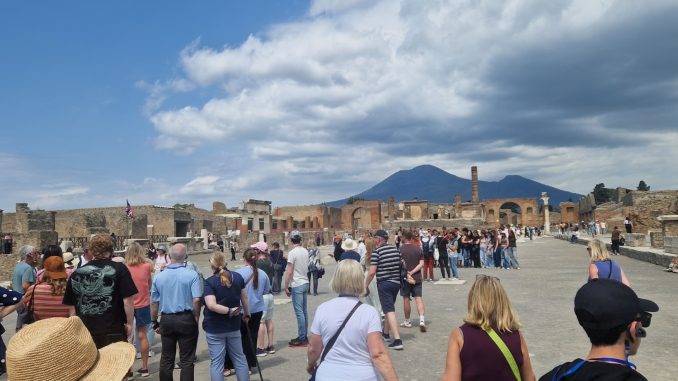
The Big One. Visiting the location for the film Pink Floyd Live in Pompeii and the birthplace of pizza. Oh, and possibly the most astounding archeological site in the world
Day 5: Naples, Wine Tasting & Pompeii: After breakfast, depart for a panoramic guided tour of Naples, a vibrant city rich in art, history, and street life. Drive along the beautiful seaside quarters of Posillipo, Santa Lucia, and Mergellina, followed by a walking tour of the monumental centre: Piazza del Plebiscito, Royal Palace, San Carlo Opera House, and the Galleria Umberto I. Continue to a vineyard on the fertile slopes of Mount Vesuvius for a wine tasting featuring the famous Lacryma Christi wines, paired with a rustic lunch. In the afternoon, journey to the archaeological site of Pompeii, where a licensed guide will lead you through the well-preserved streets, houses, and public buildings frozen in time by the 79 AD eruption. Return to your hotel for dinner and overnight.
There are few places in the world that can match the beauty of the Amalfi Coast and the Campania Region. But if anyone tries it on with ‘what about Croatia’, Naples just stands up, says ‘hold my pint’ and pulls out the Pompeii card, then sits back down and relaxes. The ancient city of Pompeii is a unique historic site that combines history, science and the natural world to trump anywhere else on the planet.
Contrary to the itinerary, it was our first stop today.
Pompeii was a wealthy hangout for the rich and famous, like Larucio, Senna The Suthsayer and Plautus (Played by Frankie Howard, Jeanne Mockford and Willie Rushton, respectively, in the Hollywood bio-pic, ‘Up Pompeii). It was the Monte Carlo of its day, and recent archeological digs have revealed that they used to ‘have it large’ on a regular basis. It was a real den od iniquity with brothels galore.
It all came to an abrupt end on 24th August 79BC, when Jupiter looked down on all the fornication and sent his homie Vesuvius to sort ’em out. They had already had a yellow card fifteen years earlier, when Jupiter sent an earthquake. They were still rebuilding on that glorious August day, in the middle of Wimbledon Fortnight, when god gave them the red card. This big big fuck off mountain exploded and covered the surrounding area with ash, lava and all the sort of stuff that goes with a gaseous pyroclastic flow.

We know the date so accurately, because 17 year old Pliny the Younger watched it from his house down the road and blogged about it at the time.
Thus Pompeii was consigned to the dustbin of history. The town was covered in 6m of volcanic ash and hidden from view. Anything visible was nicked and recycled by locals. The town was soon forgotten. It wasn’t until 1592, when Domenico Fontana stumbled upon the remains of the town whilst digging a canal, that anyone knew it was there. It was another two centuries before serious excavation began in 1748. Even today, huge areas of Pompeii are yet to be uncovered.
It’s only April but the crowds entering Pompeii today are starting to build up as we arrived. Unfortunately, the main concert hall where Pink Floyd appeared in 1972 is not open to the public today, they are doing the soundcheck for Up Pompeii the Musical.
Victoria proceeds to drag us around these astonishing remains jamming information into our heads. She is incredibly knowledgeable, whether telling us about churches on Capri, lemon growing in Sorrento or walking through a two thousand year old ruin.

The nature of that pre-Jesus disaster is still debated today, but whatever the science behind it, Pompeii is incredibly well preserved, with frescoes on the wall, ancient ovens, and even human remains still intact. We wander in awe trying to take it all in. There’s a lot of scaffolding about as experts are still rebuilding some of the town.
Victoria is ruthlessly trying to cram information into our heads, which are already overflowing with new facts. It is astonishing how much has been learned from the remains. It is possible to work out the minutest details of daily life, from how they grew food and cooked it, to what sexual positions were available in the brothel. There are literally paintings still on the wall reminiscent of the karma sutra.
The Romans, as any school kid knows, were a bit handy when it came to building roads. There are very clearly defined footway, kerbs and carriageways. There are even speed bumps. These cobbled roads are incredibly well preserved, although trying to negotiate them in the Italian heat with only one functioning eye and Victoria trying to ram information into my head ceases to be fun after a while.

At the end of our tour we are whisked into the museum where the legendary casts of the people preserved by the volcanic ash are on display. There’s a lot more than just the casts, but we are behind schedule so are soon back on the bus heading for lunch.
Our next stop is a vineyard on the slopes of Mount Vesuvius. I’m still trying to get my head around why volcanic ash is such a good growing material. It has come from the centre of the earth, it’s not organic, yet plants thrive in it. That eruption, although it killed everything it touched,was like a fountain of manure raining down, scattering fertiliser for future generations to grow their lemons, olives and grapes.
We sit down in a small restaurant and are given a taste of all the wines available. Red, white, rose, sparkling and some ridiculously strong stuff that came in a shot cups. Oh, and we had spaghetti.
The wine is served in a traditional wine glass, but it’s a tasting session, not a piss up, so there are only small amounts of each wine. I’m not really a wine drinker, but thats probably because I’ve always tried cheap wine. These wines are quite tidy.
Hmmm. That’s not really good enough is it. You could taste the sun and the succulent fruity taste provokes visions of pyroclastic clouds falling from the sky.

Bizarrely, all drinks are drunk out of the same glass. So with the exception of the first drink, every drink had traces of all the previous wines. I’m not sure that’s how wine tasting should be done.
Tasting done, we head to Naples. The city is even older than Rome. It’s the largest city in Southern Italy and the third largest city in Italy (after Rome and Milan). Sitting on the coast it was actually founded by the Greeks and is one of the oldest continuously occupied cities in the world.
It’s a sprawling city and in places quite run down. We drive along the front taking in the view of castles and cruise ships. Victoria doesn’t stop telling us about the history but little sinks in. I’m going to have to start forgetting stuff so I can squeeze new memories in.
I do recall her saying that Naples was the only city not liberated from the Nazis. They rose up and liberated themselves. There’s a statue dedicated to the lads what done it.
Its densely populated narrow streets were a breeding ground for cholera for many years, and the locals came up with a way of killing germs in their food. Frying their bread. I knew fried bread was healthy, but nobody would listen.
The recipe evolved over the years. Flatbreads were an idea that possibly made their way over from Greece. It was primarily a food for poor working people. It’s cheap, easy to make and portable. What we now know as the modern pizza was basically born in the 19th century and had a massive boost in on 11th June 1889, when Queen Consort Margherita popped down to Naples to check out the local food and Raffaele Esposito rustled up a pizza featuring the colours of the Italian flag using tomatoes, mozzarella and basil. Thus the Margherita pizza was born. She went home and bigged up the pizza and this Naples local dish started to spread around the country.
At this time Italy was on it’s arse, so many Italians emigrated to find fame and fortune. Many migrated to South Wales to provide coffee and ice-cream for miners, whilst others went to USA taking the cheap pizza recipe with them. Americans did what Americans do, and turned this cheap and easy to make food into a mammoth industry, selling it firstly all over America, then all over the world. Pizza comes in many forms, from cheap frozen microwave ready meals to gourmet pizzas prepared by Michelin star chefs. But the general consensus that proper pizza is made from scratch and cooked in a stone oven.
After a brief walk through the old square, watching Veronica point at things and telling the interested things about Spanish kings and Greek generals, we soon climb back onto our bus and headed back to the hotel. Knackered.