Today was mostly a guided tour of the old city of Munich with lots of history and shit. And some drinking.
Many people often ask, actually some people occasionally ask – actually I think someone asked. Once – ‘When do you have time to write your blogs, Clint?’ The truth is, there is no one answer. My match day blog from yesterday was written on the bus from Valduz to Munich. I got so pissed in Krakow last week I still haven’t finished writing that blog. This particular blog, I am starting after being overserved in several bars and after drinking far more Christmas Mojitos than the inventor of Christmas Mojitos ever intended to be necked in one sitting.*
Again, we were up at the crack of noon and decided to start our afternoon with another vegan currywurst just to settle our stomachs. What’s a currywurst? Read part two of this trip’s blog. I can’t be repeating myself all the bloody time.

We washed down our food with a local brand of Cola, which reminds me of an interesting tale – again connected to world war two.
COCA-COLA AND THE NAZIS: During the Second World War there was a trade embargo, which meant Coca-Cola were unable to get the ingredients for Coca-Cola into Germany. To keep the German branch of the company alive, they invented a new drink just for the German market. Fanta. The head of Coca-Cola’s German subsidiary, Max Keith, was able to keep the company running by collaborating with the Nazi government to secure supplies, though there is no evidence that Keith himself was a Nazi.
After the war, the original Fanta production ceased, but the brand was later reformulated and relaunched as Fanta Orange in Italy in 1955, eventually becoming the globally recognized drink it is today.

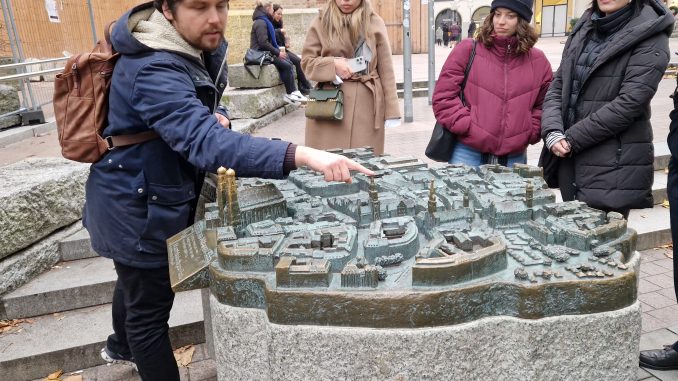
We then went for a bit of a bimble. We had booked onto a walking tour via our old friend, the ‘Free Tour’ app. It’s an app we have used on many of our trips: basically a local guide with inside knowledge of your destination takes you for a walk and gives you some historical info about the hood. All for free. However, it is customary to slip the guide a tip at the end. Not compulsory, but customary.
We meet up with Patrick, an affable young chap who has lived in Munich for thirteen years. He makes a point of telling us that, whilst Munich is obviously in Germany, it is first and foremost Bavarian. Bavaria is part of Germany but considers itself to have its own identity. A bit like Yorkshire, Cornwall and Liverpool refuse to consider themselves English, Monmouth thinks it’s really part of England, and Grove Park refuses to accept it is part of Cefn Fforest.
There’s a fine line between patriotism and nationalism. Many nationalists have been putting up flags around England recently, claiming it to be an act of patriotism. Nationalism and far-right politics have been on the rise around Europe for a few years now. But of all the countries that know the consequences of far right politics and policies, Germany has the most reason to be cautious.
There’s a standing joke, with TV Comedy character Basil Fawlty. When there are Germans around, you ‘Don’t mention the war’. But in Munich, the birthplace of the National Socialist Party, a city devastated by allied bombing, it’s difficult to avoid the subject. Patrick touched on the subject throughout the tour, but with discretion and delicately. It’s complicated. To put it mildly. There’s the element of wanting to distance themselves from the past, but also the realisation that it is important to remember the past to avoid repeating it.
Appropriately, we start the tour in Viscardigasse, a small alley connecting two thoroughfares. It is near the site of a big battle between the Bavarian Police and the fledgling Nazi party (see day two for the story of the Beer Hall Putsch). The Nazis were defeated, but only temporarily. When the Nazis eventually took power a shrine was erected to mark the battle. It was compulsory to salute the shrine when you walked past and failure to do so could result in execution. They even had a twenty-four hour guard to enforce the rule. To avoid the shrine many took a diversion down , thus avoiding saluting or punishment for not saluting. It is a cobbled street, but with a line of bronzed cobles. Each bronze cobble represents someone who had been executed for not saluting. This is why we do walking tours, it would have been easy to walk past, oblivious to the street’s significance.

We then start a tour of some of the significant buildings in the old town. Whilst some of them are several hundred years old, few of them are completely original. Munich suffered heavy damage from Allied bombing in the Second World War. It faired slightly better than cities like Dresden, because it was so far from UK airstrips, but it still took a battering. Although there were no industrial or military targets, it was considered to be the home of Nazism, so was given a symbolic kicking.
Many of Munich’s older buildings were built from limestone rock. After the war, a combination of a shortage of limestone and a shortage of skilled workers, meant that many buildings were reconstructed very simply with bricks and a cement skim, then original architectural features, such a columns and gargoyles, painted on. There are some though that have had a more sympathetic restoration to their former grandeur.

We hear of Crown Prince Ludwig who got married in 1810. Royal weddings were not normally for the likes of you and I, but Ludwig decided to have a beer festival in the run up to the wedding that would be open to everyone in Munich. Like a massive stag/hen party. It was so popular it became an annual event and is still held on the same site some 215 years later. No longer an event just for locals, people travel from all over the world to come for the festival. This year 6.5 million pissheads came to get shitfaced at Octoberfest. (See part one of this blog for my memories of what a nightmare that is.)
We walk across a park to a war memorial to the dead of both world wars. The Kriegerdenkmal is a sunken tomb-like structure with a sculpture of a resting soldier as a centerpiece.

It sits outside the Bavarian Chancellery, which was heavily damaged in the war. The two wings of the building were reconstructed using a contemporary glass and steel design, but the centre of the building is as originally built – with the addition of a few bullet holes which have not been repaired, as a reminder of the consequences of Nazism. We stand for a while in contemplation of the perils of war and Patrick gives us some thoughts on World War II and the contemporary German psyche.

We wander back to the old town and look at some churches. Catholicism is big in Bavaria and there are five large Catholic churches in Munich old town centre. They vary from the obscenely opulent, to enormous but deliberately plain (churches are for praying not bling). Four of them have huge towers so they can be spotted by worshipers from around the rest of the town, but the royal church has no towers, because the royal family know where it is and you’re not invited.

We end the tour in front of the New Town Hall (see episode two of this blog to find out how new it isn’t). We hear details of the famous glockenspiel on the front of the town hall and Patrick recommends we go up the tower to view the old town. It is getting dark though, so we give it a miss. We are also hungry, so after tipping our man, we get advice on where to eat.

Soon we are in Ayinger Am Platzl, a traditional Bavarian restaurant opposite the Hofbrauhaus (see episode two). It is a large restaurant and we are welcomed by a young English girl. She shows us to a table and we are soon being served by a gentleman wearing traditional Bavarian costume – as are all the staff here.
Bavarians are not big on veggie food, but we soon find ourselves noshing down on Kasepatzle, a dish made from potatoes, cheese and pears, and Semmelknodel, a traditional dumplingish thingy made with beetroots.

Both are incredibly delicious and before we know it we too full to even consider desert. Or at least a solid desert. Old Lederhosen chap persuades us to have shots of Pear Schnapps decanted from an enormous bottle.

After waddling out of the restaurant we get a cab and head back to the familiar surroundings of our hotel bar. The Bargoed Massive are also there – having been too tight to book a hotel with a bar of their own. Over the next few hours the barman gets repetitive strain from spending most of the evening making Christmas Mojitos.
Christmas Mojitos Ingredients
Lime juice, Fresh mint leaves, Sugar, White rum, Coconut rum, Canned coconut milk, Sparkling water, Pomegranate arils

Eventually we retire to our room in preparation for tomorrow’s flight home. Another Wales Away ticked off – last of 2025. Who knows what 2026 will have in store for us? A World Cup maybe?
Footnotes
*Blog mostly finished sat in Munich Airport departure lounge.
** Yes, I know, only one of the people in this photo is from Bargoed, but ‘The Bargoed, Cardiff, Wrexham and Ystrad Mynach Massive doesn’t have the same ring to it
TO BOOK A WALKING TOUR WITH PATRICK, GO TO Munich Free Tour: History, Humor & Local Insights – Munich | FREETOUR.com